
Category

Psychedelic Therapy Retreat

From Boardroom to Bliss: Why Every Entrepreneur Needs a Retreat

By Psychedelic Therapy RetreatNo Comments

A founder looking out over a serene mountain or ocean landscape from a beautiful, modern cabin - Retreat for Founders and business owners

A Retreat for Founders and business owners is a dedicated period away from daily operations, designed for deep reflection, strategic thinking, and personal rejuvenation. It’s a powerful tool to prevent burnout and spark significant personal and business growth.

  • Purpose: To gain clarity, make strategic decisions, and recharge personally.
  • Benefit: Improved mental health, increased creativity, and sustainable business growth.
  • Key Difference from Vacation: It’s an intentional investment in self and business, not just an escape.

As a founder, you’re constantly pushing. The entrepreneurial journey often brings intense anxiety and decision fatigue. This relentless pace comes at a cost: your mental clarity drops, and fresh ideas become scarce. Studies show that even a few days away can dramatically improve performance, yet many leaders work through their vacations, missing out on true rest.

You might feel you can’t step away, but as the saying goes, “You can’t see the picture when you’re inside the frame.” This guide will show you how a strategic pause isn’t an indulgence. It’s a critical investment in your most valuable asset: you. It’s how you realign your vision and ensure both your personal well-being and your business thrive for the long haul.

Infographic explaining the cycle of founder burnout, showing stress points like decision fatigue, isolation, and constant pressure, and how a retreat introduces elements like clarity, rest, new perspectives, and strategic planning to break the cycle and lead to renewed energy, focus, and sustainable growth. - Retreat for Founders and business owners infographic

Why a Founder Retreat is a Strategic Investment, Not an Indulgence

The thought of stepping away from your business can feel like an indulgence. Your calendar is bursting and your to-do list is endless. But a Retreat for Founders and business owners isn’t a luxury; it’s a necessary investment in your operation’s most vital component: you.

When you’re at your best, your business shines. When founders truly rest, they return with sharpened attention, mental clarity, and brilliant “aha!” moments that don’t happen in the daily whirlwind. A well-rested, clear-headed founder is a powerful force, ready to avoid costly slip-ups and lead with a clear, sustainable vision.

A founder journaling with a focused, clear expression in a peaceful setting - Retreat for Founders and business owners

The Critical Difference: Retreat vs. Vacation

What’s the real difference between a vacation and a Retreat for Founders and business owners? Their goals. A vacation is about escape and relaxation. A retreat is an intentional deep dive—a focused time for reflection, re-engaging with your purpose, and often, skill-building. It’s a productive pause where you tackle the big questions your busy schedule pushes aside.

This distinction is critical. A typical vacation doesn’t provide the space for deep strategic thinking. A Harvard study on CEO vacations showed that CEOs worked through 70% of their vacation days, leaving little room to truly recharge. A retreat, however, is designed to help you unplug from the “always-on” pressure and focus on what matters most.

Calculating the ROI: Tangible and Intangible Gains

The return on investment (ROI) for a retreat includes both tangible and intangible benefits.

Tangible ROI often includes:

  • New Business Strategies: Clear plans for pivots, growth, or even company sales.
  • Product Innovation: Breakthrough ideas for new products or solutions to old problems.
  • Strategic Decisions: The clarity to make big-picture choices that seemed overwhelming before.

Intangible ROI is just as vital, leading to renewed energy, mental clarity, and improved decision-making. This space for reflection boosts creativity and problem-solving skills. Most importantly, it helps prevent burnout. With 72% of founders reporting that their journey impacts their mental health, investing in your well-being is like putting premium fuel in your most valuable engine.

At Within, our immersive retreats are built with a whole-person approach, full integration support, and a focus on community to ensure your insights lead to lasting change. Learn more about how Within’s retreats support mental clarity and breakthrough insights.

The Founder as the Core Business Asset

You are the main engine of your business. Your company’s success is directly tied to your personal well-being. If your most important machine is sputtering, the whole factory struggles. Taking care of yourself isn’t selfish; it’s the smartest thing you can do for your company. It leads to sustainable leadership, helps you avoid costly mistakes, and keeps your focus on the long-term vision instead of daily fires.

The Essential Guide to a Retreat for Founders and Business Owners

Ready to take the plunge? Planning a successful Retreat for Founders and business owners is about creating an intentional experience that addresses what you and your business need right now. It requires thoughtful preparation, but this guide will walk you through crafting an experience that delivers real results.

Collage showing different retreat types: a person meditating, a group hiking, someone working on a laptop with a scenic view - Retreat for Founders and business owners

Step 1: Define Your “Why” – Setting Clear Intentions

Before booking anything, ask yourself: What am I really trying to accomplish? Your answer will shape every decision. Are you wrestling with a specific business challenge, need time for strategic planning, or craving a personal reset? Perhaps you need to tackle big-picture questions like, “Am I still passionate about this direction?” or set clear goals for personal and business growth.

Clarity is crucial. Your intention becomes your North Star, guiding your choices about location, activities, and structure. At Within, we know that true change starts with understanding what you’re seeking. You can learn about our approach to healing and growth and see how intention-setting creates the foundation for meaningful change.

Step 2: Choose Your Environment and Activities

With your “why” defined, you can explore the “where” and “what.” The world of Retreat for Founders and business owners is diverse:

  • Wellness and holistic retreats focus on well-being through yoga, meditation, and sometimes deeper modalities like psychedelic-assisted therapy.
  • Trip-based retreats combine physical challenges, like sailing or trekking, with reflection.
  • Skill-building retreats offer hands-on instruction in areas like marketing or fundraising.
  • Mastermind retreats bring together peers for shared learning and connection.
  • Workcation retreats provide an inspiring environment for focused work combined with rejuvenation.

The environment also matters. Do you need the calm of nature or the energy of a city? Decide if you want to go solo for deep introspection or join a group for networking. Do you prefer a structured agenda or unstructured time? Select an environment and activities that directly support your intention.

Step 3: Plan the Logistics – From Budgeting to Digital Detox

Now for the practical steps. With the right approach, logistics are manageable.

  • Budgeting: Retreats range from a few hundred dollars for a DIY weekend to several thousand for an all-inclusive experience. This is an investment in your business’s most critical asset.
  • Preparing your team: Create a support system at work. Delegate responsibilities, empower your team to make decisions, and communicate your plans and emergency protocols clearly.
  • Setting technology rules: Decide your level of connectivity upfront. Will you check emails once daily or go completely off-grid? The goal is to break the “always-on” cycle.
  • Packing thoughtfully: Beyond clothes, bring a journal, a meaningful book, and any personal items that foster relaxation and focus.

Overcoming the Problems: Making Your Retreat a Reality

Thinking, “This sounds great, but…” is a common and valid reaction for founders. The guilt, the fear of stepping away, the feeling that the business will crumble—these are genuine problems. But these barriers often reveal exactly why you need a Retreat for Founders and business owners in the first place. Let’s work through these challenges.

Battling the Guilt and “Indulgence” Myth

Many founders feel that taking time for personal restoration is selfish. We need to flip this script: Rest is productive. Making decisions from a place of exhaustion doesn’t serve your team or your business. Your well-being isn’t separate from your business success; it’s the foundation of it.

Shift your mindset from viewing a retreat as a “cost” to seeing it as an “investment.” You invest in equipment and training to improve outcomes; investing in your own clarity, creativity, and leadership capacity deserves the same priority. A refreshed leader makes better decisions, inspires teams, and sees opportunities that an exhausted one misses.

“The Business Can’t Survive Without Me”: Building a Support System

This fear is common, but if your business truly can’t function without you for a few days, it’s a red flag about your business structure, not a sign of your importance. Building a support system is about building a sustainable business.

Start small by delegating clear responsibility and authority. Create and document systems and processes that don’t rely solely on you. The hardest part is trusting your people, but your team needs the opportunity to prove themselves. This doesn’t diminish your value—it multiplies it. Frame your retreat to your team as an investment in becoming a better leader, which benefits everyone.

How to Choose the Right Retreat for Founders and Business Owners

With so many options, choosing the right retreat can feel overwhelming. Return to your “why” and align your choice with your goals. If you need deep personal change, a wellness retreat may be best. For strategic clarity, consider a business mastermind.

When vetting programs, look beyond glossy websites. Read testimonials and see if the organizer offers preliminary calls to ensure a good fit. The solo versus group decision is also crucial:

ProsConsBest For
Solo DIY RetreatComplete control, maximum privacy, cost-effectiveRequires self-discipline, no built-in community or guidanceFounders needing intense focus, those on tight budgets, highly self-motivated individuals
Curated Group RetreatExpert guidance, networking, shared learning, accountabilityLess flexibility, higher investment, less privacyFounders seeking community, external accountability, or structured growth experiences

If you’re hesitant, consider starting small with a weekend retreat. For those ready for a deeper dive, curated experiences like those at Within provide comprehensive support, allowing you to focus purely on your growth and healing. This is especially valuable when dealing with chronic stress, anxiety, or the need for fundamental change.

The Return: Integrating Your Insights for Lasting Impact

The retreat isn’t the finish line; it’s the starting block. The real magic happens when you integrate the learnings from your Retreat for Founders and business owners back into your daily life. Without an intentional plan, even the most profound insights can slip away.

A founder confidently leading a team meeting, sharing new ideas on a whiteboard - Retreat for Founders and business owners

From Mountaintop to Monday Morning: Creating an Integration Plan

The transition from retreat mode to business mode requires a solid plan to preserve what you’ve gained.

  • Document everything: While on retreat, journal or record your thoughts, ideas, and decisions while they’re fresh.
  • Turn insights into action: Translate abstract goals like “better balance” into concrete steps like “no emails after 7 PM.”
  • Prioritize changes: Don’t try to transform everything at once. Pick the top 1-3 most impactful changes to focus on first.
  • Create a roadmap: Use a 30-60-90 day plan to map out how you’ll implement these changes. This provides structure and accountability.

At Within, we emphasize comprehensive integration support because true change extends beyond the retreat itself. For more tips, you can Listen to our Going Within Podcast for integration tips.

Maintaining Momentum and Avoiding the Rebound

The post-retreat glow is fragile. To keep the momentum alive, make reflection a regular habit, even if it’s just 30 minutes a week. Incorporate practices you enjoyed—like morning journaling or mindful breathing—into your daily routine. When appropriate, share key insights with your team to foster a healthier company culture. If you attended a group retreat, keep those connections alive for ongoing support and accountability.

When the Retreat Reveals a Need for Deeper Work

Sometimes, a retreat reveals deeper issues like chronic burnout, imposter syndrome, or mental health challenges that require more than a few days away. This is not a failure; it’s a valuable insight. Recognizing this need is a sign of strength.

72% of founders report that their journey affects their mental health. If your retreat highlights a need for deeper healing, you are not alone. Ongoing therapy or coaching can provide long-term support. At Within, we offer ketamine-assisted therapy and holistic healing at AWKN Ranch near Austin, Texas. Our immersive approach combines deep inner work with integration and community support, designed for leaders seeking profound, sustainable change.

True healing often requires a holistic approach that addresses the whole person. You can learn more about Why a holistic approach is essential for true healing.

Frequently Asked Questions about Founder Retreats

You’ve likely got questions about taking a Retreat for Founders and business owners. Let’s address the most common ones.

How long should a founder retreat be?

There’s no magic number; it depends on your goals.

  • A weekend retreat (3-4 days) can provide a meaningful reset and a taste of the benefits.
  • 5-7 days is a sweet spot for disconnecting, working through complex challenges, and achieving deeper rejuvenation.
  • 10 days or longer may be necessary for major life transitions or addressing serious burnout.

Start with what feels manageable and build from there.

Should I go on a solo retreat or a group retreat?

This comes down to your personality and current needs.

  • Solo retreats are ideal for intense, private reflection. They allow you to dive deep into specific challenges without external input, which is great for introverts or those who think best in solitude.
  • Group retreats offer the power of connection. Being with other leaders who “get it” is healing and provides fresh perspectives. The relationships built can become an ongoing support network.

How much should I budget for a retreat for founders and business owners?

Cost is a major consideration, and the range is wide.

  • A DIY retreat can cost just a few hundred dollars for a quiet rental.
  • Structured weekend retreats often start around $899.
  • Comprehensive group retreats typically fall in the $1,600 to $5,000 range, covering accommodation, meals, and expert facilitation.
  • High-end, intensive experiences with extensive personal attention can be $8,000 or more.

The key mindset shift is to view this not as an expense, but as a strategic investment in your company’s most critical asset: you. The question isn’t “Can I afford this?” but “Can I afford not to?”

Conclusion: Your Business Needs You to Step Away

Here’s the truth: taking a Retreat for Founders and business owners isn’t just a nice-to-have anymore. It’s become essential for anyone serious about building something that lasts. Throughout this guide, we’ve shown you how stepping away strategically can transform both your mental clarity and your business outcomes.

The old hustle culture that celebrates grinding yourself into the ground? It’s not sustainable, and frankly, it’s not smart business either. Your well-being is your greatest asset, and treating it as anything less is like running your most important machine until it breaks down completely.

Think about what we’ve covered: the tangible returns from renewed creativity and sharper decision-making, the intangible benefits of preventing costly burnout, and the strategic advantage of having a leader who can see the forest for the trees. These aren’t luxuries – they’re competitive advantages.

The power of a strategic pause goes beyond just feeling better (though that’s important too). It’s about sustainable success over the long haul. It’s about being the kind of leader your team needs, making decisions from a place of clarity rather than exhaustion, and building a business that doesn’t require you to sacrifice your health to succeed.

Your business needs you at your best, not your most depleted. And sometimes, the best thing you can do for your company is to step away from it entirely.

For founders seeking a profound reset that combines deep inner work with a supportive community, Within offers immersive experiences designed for leaders to find clarity and renewed purpose. Our focus on holistic healing, integration support, and community makes us uniquely positioned to help you achieve lasting change. Your transformative journey starts here. Explore our Psychedelic Therapy Retreats.
Psychedelic Therapy in Texas: Navigating the Evolving Landscape

By Psychedelic Therapy RetreatNo Comments

Psychedelic therapy Texas - Psychedelic therapy Texas

Psychedelic therapy Texas is experiencing unprecedented growth, with the state investing $50 million in clinical trials and passing groundbreaking legislation to study psychedelic treatments for mental health conditions.

Quick Overview of Psychedelic Therapy Options in Texas:

  • Legal Now: Ketamine-assisted therapy for depression, PTSD, and anxiety
  • Research Phase: Psilocybin studies for veterans with PTSD (HB 1802)
  • Major Investment: $50 million for ibogaine clinical trials (SB 2308)
  • Leading Institution: UT Austin’s McGill Center for Psychedelic Research
  • Focus Areas: Treatment-resistant depression, PTSD, chronic pain, substance use disorders

Texas has traditionally taken a conservative stance on drug policy. But something remarkable is happening in the Lone Star State. Veterans returning from combat with invisible wounds are driving change. Traditional treatments aren’t working for everyone.

“Texas should explore the efficacy of psychedelic treatment for veterans within the state,” said State Representative Alex Dominguez, whose bill launched Texas into psychedelic research leadership.

The numbers tell the story. 7.7% of people may develop PTSD in their lifetime. Anxiety affects one-third of adults. Over 10 million Americans struggle with fibromyalgia. These conditions often resist traditional treatments.

Now, Texas is betting big on a different approach. The state has become a global leader in psychedelic research investment. Major medical institutions like Dell Medical School are conducting studies on MDMA, psilocybin, and ketamine.

This isn’t about recreational drug use. It’s about evidence-based medicine delivered in clinical settings with trained professionals. The difference matters – and it’s changing lives.

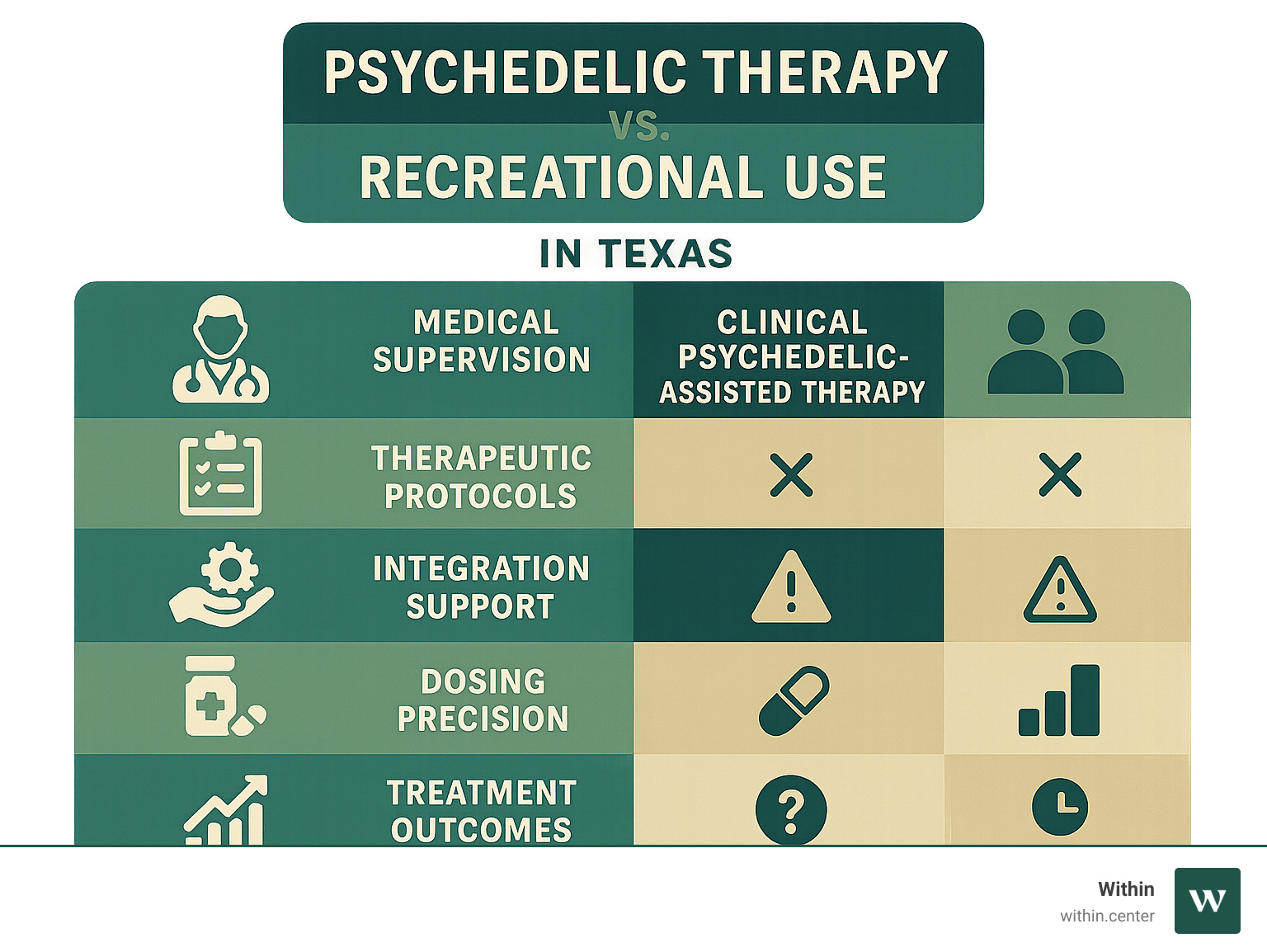
Comprehensive infographic showing the key differences between clinical psychedelic-assisted therapy and recreational drug use, including medical supervision, therapeutic protocols, integration support, safety measures, dosing precision, and treatment outcomes in Texas - Psychedelic therapy Texas infographic

The Shifting Legal Landscape of Psychedelic Therapy in Texas

Just a few years ago, the idea of psychedelic therapy Texas would have seemed impossible. Our state built its reputation on tough drug laws and conservative policies. But sometimes, crisis creates change.

The mental health crisis hit Texas hard. Our veterans came home carrying invisible wounds that traditional treatments couldn’t heal. Families watched loved ones struggle with PTSD, depression, and addiction. Something had to give.

What happened next surprised everyone. Republicans and Democrats started agreeing on something: we needed new solutions. The evidence was too strong to ignore. Studies from other states and countries showed these medicines could help where everything else had failed.

of the Texas State Capitol building in Austin; Texas legislation; Schedule I substances; Bipartisan support; State-funded research; Economic benefits for Texas. - Psychedelic therapy Texas

Texas lawmakers found a smart path forward. While substances like psilocybin and MDMA remain Schedule I under federal law, the state could fund rigorous research. This approach keeps strict oversight while exploring real therapeutic potential.

The economic benefits matter too. Texas leaders realized other states and countries were racing ahead in psychedelic research. Why should Texas miss out on the next breakthrough in mental health treatment?

The Breakthrough Bills: HB 1802 and SB 2308

Everything changed in 2021 with House Bill 1802. Texas became the first state to directly fund psychedelic research with taxpayer dollars. The focus? Psilocybin-assisted therapy for veterans with PTSD.

This wasn’t a small pilot program. It was a bold statement that Texas takes care of its own.

Then came Senate Bill 2308 in 2023. Governor Greg Abbott signed it into law, creating a clinical trial consortium to study ibogaine. This plant medicine shows promise for treating opioid addiction, PTSD, and other mental health conditions.

The real shocker? Texas committed $50 million to this research. That’s more than most countries spend on psychedelic studies. You can read the full bill here to see just how comprehensive this commitment is.

The advocacy from Texas leaders made all the difference. Former Governor Rick Perry’s story stands out. He started as a skeptic but changed his mind after meeting a Navy SEAL veteran struggling with brain injury, PTSD, and addiction. Perry saw how traditional treatments weren’t working. He became convinced that ibogaine could offer hope.

His willingness to follow the science, even when it challenged his previous beliefs, helped build bipartisan support. The message was clear: Texas wants to lead this research, not follow from behind.

Key Research Initiatives in Texas

Texas universities and medical centers jumped at the opportunity. Major institutions started forming partnerships to conduct world-class clinical trials.

The crown jewel is the Charmaine and Gordon McGill Center for Psychedelic Research and Therapy at Dell Medical School at UT Austin. It’s the first center of its kind in Texas, dedicated entirely to advancing psychedelic medicine.

Their research covers treatment-resistant depression, PTSD, traumatic brain injuries, anorexia nervosa, and prolonged grief. These aren’t just symptom studies. Researchers are diving deep into how these medicines work in the brain.

The focus on PTSD and TBI reflects Texas’s commitment to veterans. These conditions often go hand-in-hand, especially for combat veterans. Traditional treatments help some people, but too many fall through the cracks.

Texas research teams are getting creative with technology too. They’re exploring AI and machine learning to predict which patients might benefit most from specific treatments. The goal is personalized medicine that gives each person the best chance at healing.

This isn’t about rushing treatments to market. It’s about doing the science right, so when these therapies become available, we know they work and who they work best for.

The Science of Healing: How Psychedelics Can Rewire the Brain

When you hear about psychedelic therapy Texas breakthroughs, you might wonder what’s actually happening in the brain. The truth is, these aren’t just mystical experiences – they’re profound neurobiological events that can literally help your brain form new connections.

Think of your brain like a well-worn path through the woods. Depression, anxiety, and trauma create deep ruts that your thoughts keep falling into. Neuroplasticity – your brain’s amazing ability to reorganize itself – is how psychedelics help create new pathways through that forest.

The magic happens in your serotonin system, particularly in brain regions that control emotion, memory, and how you see yourself. There’s a network called the default mode network (DMN) that’s often overactive when you’re struggling with mental health conditions. It’s like having a broken record player stuck on negative thoughts about yourself.

Psychedelics temporarily quiet this chatter. Many people describe a sense of “ego dissolution” – that critical inner voice goes quiet, and suddenly you can see your life from a completely different angle. This creates space for emotional breakthroughs that seemed impossible before.

of brain scans showing increased neural connectivity; Neuroplasticity; Serotonin system; Default mode network; Ego dissolution; Emotional breakthrough. - Psychedelic therapy Texas

MDMA and Psilocybin: Mechanisms and Benefits

Let’s talk about how specific compounds actually work in your brain:

MDMA-assisted therapy has shown incredible promise for PTSD. MDMA affects your serotonin system in a unique way that reduces fear while increasing feelings of safety, empathy and connection. It’s like having a trusted friend sitting with you while you process difficult memories.

The compound helps with fear extinction and memory reconsolidation – essentially, your brain learns to file traumatic memories in a less threatening way. Instead of those memories triggering your fight-or-flight response, they become just memories. Two major Phase 3 clinical trials showed that people with severe PTSD experienced dramatic improvement after MDMA-assisted therapy.

Psilocybin-assisted therapy works differently but just as powerfully. The active compound in “magic mushrooms” often creates what researchers call “mystical experiences” – profound feelings of connection, meaning, and insight. These experiences are strongly linked to healing outcomes.

Psilocybin has powerful anti-depressant effects and may even help grow new brain cells. People often describe feeling more open, flexible, and connected to others after treatment. This represents a fundamental shift in how we approach mental wellness, as we explore in The Future of Healing: How Psychedelic Therapy and Plant Medicine Are Changing Mental Health.

Texas researchers are also studying ibogaine, which showed remarkable results in a 2024 Stanford study. Veterans with traumatic brain injury saw significant improvements in PTSD, anxiety, and depression after treatment.

What makes these therapies special is that they often provide faster, more robust, and longer-lasting relief than traditional treatments. They don’t replace conventional therapy – they improve it by creating windows of opportunity for deep healing.

Challenges in Research: Blinding and Expectancy

Here’s the thing about studying psychedelics – they’re really hard to research using traditional methods. When someone takes psilocybin or MDMA, they know they’re not getting a sugar pill. This creates what scientists call the “blinding problem.”

If you know you’ve received the active drug, your expectations might influence how you feel afterward. This placebo effect and expectancy bias make it challenging to prove that the improvements come from the medicine itself rather than just believing it will work.

Researchers are getting creative with solutions. Some use “active placebos” that create mild physical sensations without the full psychedelic experience. Others focus on objective measures like brain scans rather than just asking people how they feel.

The need for rigorous studies is why Texas’s $50 million investment matters so much. We need larger studies with diverse participants, especially veterans, to build rock-solid evidence. The VA evidence brief on psychedelic research provides detailed information about current research standards and findings.

Despite these challenges, the preliminary results are so promising that major medical institutions across Texas are dedicating significant resources to this research. The science is complex, but the potential for healing is undeniable.

Current Therapeutic Options in Texas

If you’re living in Texas and wondering about accessing psychedelic therapy Texas options today, you’re not alone. The landscape is evolving rapidly, but the reality is that most psychedelics like psilocybin and MDMA are still only available through approved clinical trials.

The good news? There’s one powerful exception that’s already helping thousands of Texans heal from depression, PTSD, and anxiety.

No matter which therapeutic approach you choose, success depends on three critical elements: your mindset going in, the environment where you receive treatment, and the support you get afterward. These aren’t just nice-to-haves – they’re the foundation that determines whether your healing journey creates lasting change or just temporary relief.

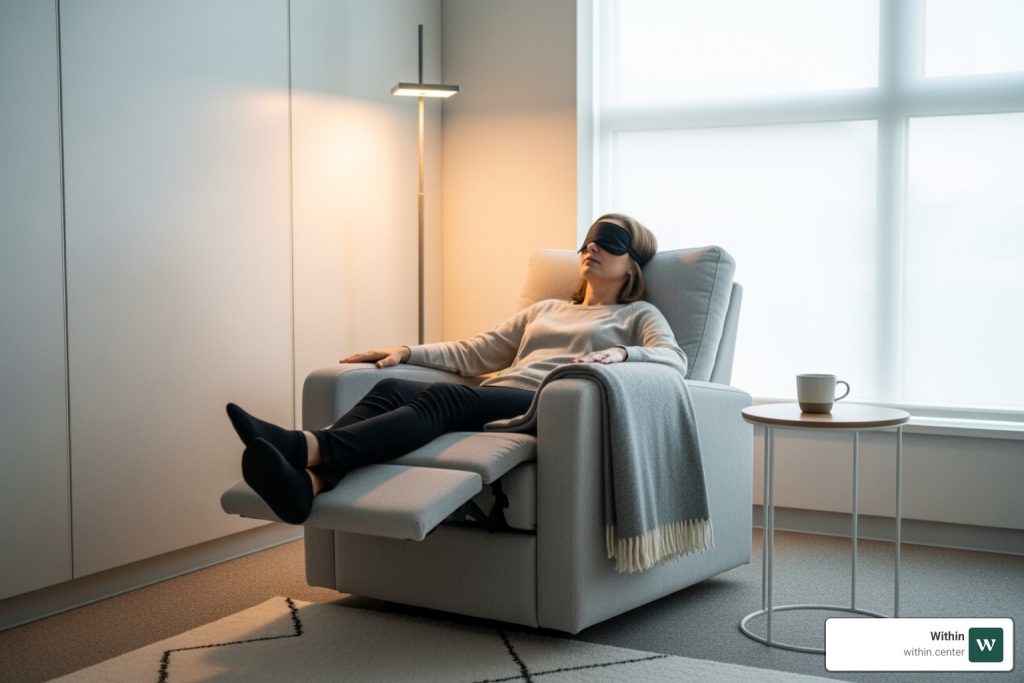
of a calm and safe therapeutic room with a comfortable chair and soft lighting; Available treatments; Legal pathways; Clinical considerations. - Psychedelic therapy Texas

Ketamine-Assisted Psychotherapy: The Legal Pathway

Here’s what makes ketamine different from other psychedelics: it’s already FDA-approved and completely legal for mental health treatment in Texas. Originally used as an anesthetic, doctors finded its remarkable ability to treat conditions that don’t respond to traditional medications.

Ketamine works by creating what’s called a “dissociative experience.” This might sound scary, but it’s actually therapeutic. For a brief time, you step outside your usual thought patterns and emotional defenses. Imagine being able to observe your trauma or depression from a different perspective – one where you’re not trapped inside it.

The results can be dramatic. While traditional antidepressants take weeks or months to work (if they work at all), ketamine often provides relief within hours or days. It literally helps your brain form new neural pathways, breaking free from the rigid patterns that keep you stuck in suffering.

This is exactly why we focus on ketamine-assisted therapy at Within. It offers a safe, legal pathway to the kind of profound healing that was once only possible in research settings. If you’re curious about how this approach works, we’ve explained the details in What is Ketamine Therapy?.

The Importance of Set, Setting, and Integration for Psychedelic Therapy Texas

Every successful psychedelic experience – whether it’s ketamine, psilocybin, or MDMA – depends on three fundamental elements. Get these wrong, and even the most promising treatment can fall short. Get them right, and you create the conditions for genuine change.

Your mindset, or “set,” is where healing begins. This means approaching the experience with clear intentions, realistic expectations, and an open heart. What are you hoping to heal? What patterns are you ready to release? The preparation work you do beforehand – often through therapy sessions – sets the stage for everything that follows.

Your environment, or “setting,” needs to feel completely safe and supportive. This isn’t just about comfortable furniture and soft lighting (though those matter too). It’s about having trained professionals who understand what you’re going through, who can guide you through difficult moments, and who create a container where you feel protected enough to be vulnerable.

Integration is where the real work happens. The insights and breakthroughs you experience during a session are just the beginning. Without proper integration support, those profound realizations can fade like a dream. True healing requires translating what you’ve learned into actual changes in your daily life – new habits, healthier relationships, different ways of thinking about yourself and your past.

This is why we believe so strongly in comprehensive integration support. A powerful experience without integration is like planting seeds without watering them. As we explore in detail, Why Ketamine Alone Isn’t Enough, and What True Healing Requires.

Participating in Research: Clinical Trials for Psychedelic Therapy Texas

Want to access cutting-edge treatments like psilocybin or MDMA therapy? Clinical trials are currently your only legal option in Texas. These studies are carefully designed to test both safety and effectiveness, which means they come with strict requirements.

The screening process is thorough – and for good reason. Researchers need to make sure these powerful treatments are safe for each participant. They’ll look at your medical history, current medications, and psychological profile. Certain conditions like a history of psychosis or serious heart problems might disqualify you, but many people with treatment-resistant depression, PTSD, or anxiety disorders are good candidates.

The University of Texas at Austin is leading much of this research through their McGill Center for Psychedelic Research and Therapy. If you’re interested in exploring these opportunities, you can Participate in Psychedelic Trials at UT Austin.

Veterans have particularly strong opportunities to participate in research, thanks to Texas legislation specifically funding studies for PTSD and traumatic brain injury. These trials represent hope for those who’ve served our country and are still fighting battles at home.

Participating in research isn’t just about accessing new treatments – you’re also contributing to the scientific understanding that will help countless others in the future. It’s a way to be part of the solution to our mental health crisis.

Frequently Asked Questions about Psychedelic Therapy in Texas

The world of psychedelic therapy Texas can feel overwhelming. We get it. Between changing laws, new research, and different treatment options, it’s natural to have questions. Let’s clear up the most common concerns we hear from people exploring this healing path.

Is psychedelic therapy legal in Texas?

The short answer? It depends on what we’re talking about.

Most psychedelics like psilocybin and MDMA remain Schedule I controlled substances under federal law. This means they’re illegal for general use, whether recreational or therapeutic. The only legal access right now is through FDA-approved research studies – like the groundbreaking trials funded by Texas’s HB 1802 and SB 2308.

But here’s where it gets interesting. Ketamine is completely different. As an FDA-approved anesthetic, licensed medical professionals can legally prescribe and administer ketamine for mental health conditions. This “off-label” use has opened the door for ketamine-assisted therapy across Texas.

The key is working with qualified professionals in proper clinical settings. There’s a world of difference between illegal “psychedelic therapy” offered by unlicensed individuals and legitimate ketamine-assisted therapy provided by trained medical teams. Safety and legality go hand in hand.

Who is a good candidate for psychedelic-assisted therapy?

Think of someone who’s tried everything else without finding lasting relief. Maybe traditional antidepressants didn’t work. Perhaps years of talk therapy helped but didn’t fully resolve deep trauma. These are often the people who benefit most from psychedelic-assisted approaches.

Common conditions that respond well include:

  • Treatment-resistant depression
  • PTSD (especially in veterans)
  • Severe anxiety disorders
  • Substance use disorders
  • Chronic pain conditions
  • Traumatic brain injuries
  • Eating disorders like anorexia
  • Prolonged grief

But being a good candidate isn’t just about having the right diagnosis. A thorough medical and psychological screening is absolutely essential. We need to rule out conditions like psychosis, certain heart problems, or bipolar disorder that could make treatment risky.

The best candidates are stable enough to engage fully in the process. They’re committed to doing the preparation work beforehand and the integration work afterward. This isn’t a quick fix – it’s a journey that requires dedication.

How does this therapy differ from traditional mental health treatments?

Imagine the difference between managing a problem and actually solving it. That’s often how people describe the contrast.

Traditional treatments usually focus on symptom management. Daily medications can help you function better. Weekly therapy sessions gradually work through issues. Both are valuable, but they often take months or years to create significant change.

Psychedelic therapy Texas approaches work more like a catalyst. Instead of daily medications, you might have just a few intensive medicine sessions over several weeks. But these aren’t just drug sessions – they’re combined with extensive therapy before, during, and after the psychedelic experience.

The magic happens because psychedelics temporarily lower psychological defenses. Suddenly, you can access memories, emotions, and insights that felt locked away. Trauma that seemed impossible to process becomes workable. Patterns that felt permanent start to shift.

This approach aims to address root causes rather than just symptoms. Many people report more rapid and lasting changes compared to traditional methods. The therapy component is crucial to making these insights stick, which is why we emphasize the importance of proper therapeutic support in How Important Is the Therapy Component of Ketamine Therapy?.

The integration phase – where you make sense of your experience and apply insights to daily life – is what transforms a powerful experience into lasting healing. Without this piece, even profound psychedelic experiences can fade without creating real change.

Conclusion: The Future of Mental Wellness in the Lone Star State

Something remarkable is happening in Texas. Our state has become an unexpected champion in mental health innovation. While we’ve traditionally been known for our conservative approach to many issues, the mental health crisis – especially among our veterans – has sparked a different kind of Texas revolution.

The numbers speak for themselves. $50 million invested in clinical trials. Two groundbreaking bills passed with bipartisan support. Major medical institutions conducting cutting-edge research. This isn’t just policy – it’s hope taking action.

Texas as a research leader means more than just funding studies. It means we’re creating a new pathway for healing that could transform lives across the nation. Our focus on evidence-based medicine, delivered in safe clinical settings, sets the standard for how psychedelic therapy Texas should develop.

A new frontier for mental health is emerging right here in the Lone Star State. Veterans who’ve served our country with honor are finally getting the innovative treatments they deserve. But this isn’t just about our military heroes – it’s about every Texan struggling with treatment-resistant depression, PTSD, chronic pain, or anxiety.

The hope for veterans and civilians extends beyond just accessing new medications. It’s about fundamentally changing how we approach mental wellness. Instead of managing symptoms indefinitely, we’re exploring therapies that can address root causes and create lasting change.

But here’s what we’ve learned from our work at Within: the medicine is only part of the story. The critical role of safe, supportive, and holistic environments cannot be overstated. A profound experience in the wrong setting can be ineffective or even harmful. The right environment – with trained professionals, comfortable spaces, and comprehensive support – makes all the difference.

The power of community and integration transforms temporary insights into permanent healing. At Within Center, we’ve seen how our immersive, live-in retreat experience creates the foundation for real change. It’s not just about the ketamine session – it’s about the preparation beforehand, the supportive community during treatment, and the integration work that follows.

Within Center’s approach to healing reflects what we believe the future of mental wellness looks like. We combine the best of modern psychedelic science with the wisdom of holistic care. Our location at AWKN Ranch near Austin puts us at the heart of Texas’s mental health revolution, offering legal ketamine-assisted therapy in a setting designed for deep healing.

The future is bright for mental wellness in Texas. As research continues and new treatments become available, we’ll be here – providing safe, legal, and transformative care for anyone ready to begin their healing journey.

Explore ketamine retreat options.

What is Ketamine-Assisted Psychotherapy?

By Ketamine Retreat, Psychedelic Therapy RetreatNo Comments

Ketamine assisted psychotherapy (KAP) combines the rapid-acting effects of ketamine with traditional psychotherapy to treat mental health conditions that haven’t responded to other treatments. This emerging therapy offers new hope for people with treatment-resistant depression, PTSD, anxiety, and other challenging conditions.

What is Ketamine-Assisted Psychotherapy?

  • A treatment that uses low doses of ketamine alongside therapy sessions
  • Helps create new neural pathways while processing difficult emotions
  • Shows rapid results, often within hours to days
  • Combines medicine’s neuroplasticity effects with therapy’s healing power

Key Benefits:

  • Fast-acting relief from depression and anxiety symptoms
  • Improved therapy outcomes through increased brain flexibility
  • Breakthrough experiences that traditional therapy alone may not achieve
  • Lasting change when combined with proper integration

When traditional therapy and medications fall short, many people feel hopeless. As one researcher noted in recent studies, ketamine has become “the first psychedelic drug approved by the FDA for treatment-resistant depression” in 2019, opening doors that seemed permanently closed.

This isn’t just another treatment option. KAP works differently than standard antidepressants by targeting the brain’s glutamate system instead of serotonin. It creates a unique window of neuroplasticity – a time when your brain becomes more flexible and open to change.

The therapy happens in three main stages: careful preparation with your therapist, the actual ketamine session with professional support, and integration work to make sense of your experience and create lasting change.

Infographic showing the three-stage KAP process: Stage 1 - Preparation (therapist and patient discussing goals and setting intentions), Stage 2 - Dosing Session (patient in comfortable setting with medical monitoring and therapeutic support), Stage 3 - Integration (processing insights and experiences to create lasting behavioral change) - Ketamine assisted psychotherapy infographic

The Science Behind KAP: How Ketamine Rewires the Brain

At the heart of Ketamine assisted psychotherapy lies a fascinating interaction with our brain’s chemistry. Unlike conventional antidepressants that primarily target serotonin, ketamine works on the glutamate system, a major excitatory neurotransmitter. By temporarily blocking a key receptor (NMDA), ketamine triggers a release of Brain-Derived Neurotrophic Factor (BDNF).

BDNF is often called “brain fertilizer” because it promotes neuroplasticity—the brain’s ability to form new connections and reorganize itself. This process, known as synaptogenesis, allows the brain to literally rewire itself, creating new, healthier pathways. This is believed to be the reason for ketamine’s rapid-acting antidepressant effects, with many patients reporting improvements within hours to days, a stark contrast to traditional medications.

Scientific research on ketamine’s mechanisms

The Role of the Dissociative Experience

Beyond its neurobiological effects, ketamine’s ability to induce a dissociative state is a key component of its therapeutic power. This temporary shift in perception, often described as a feeling of detachment from one’s body or usual thoughts, can lower psychological defenses. This allows for the safe exploration of painful emotions or memories that might be too overwhelming in traditional talk therapy. Patients often report gaining new, objective perspectives on their struggles, leading to profound insights and emotional release.

Systematic review of KAP’s active mechanisms

From Anesthetic to Antidepressant: A Brief History

Ketamine was first synthesized in 1962 and approved as an anesthetic in 1970. Its safety and effectiveness made it a staple in operating rooms and on battlefields. Researchers in the 1970s noted its potential for psychotherapy, but this exploration was largely paused during the “War on Drugs.” Renewed scientific interest has since propelled ketamine back into the spotlight, culminating in the 2019 FDA approval of a ketamine-derived nasal spray (esketamine) for treatment-resistant depression, marking a new era for psychedelic-assisted therapies.

The Complete Guide to Ketamine-Assisted Psychotherapy (KAP)

Ketamine assisted psychotherapy is a structured process designed to maximize therapeutic benefits while ensuring patient safety. It’s a holistic experience that combines medicine with expert therapeutic guidance. This section explains the typical protocol and what a patient can expect.

The Three Pillars: Preparation, Session, and Integration

Our approach to Ketamine assisted psychotherapy is built upon three crucial pillars: preparation, the dosing session, and integration. Each stage is vital for a safe, meaningful, and lasting therapeutic outcome.

  1. Preparation Sessions: Before your first ketamine dosing session, you’ll engage in preparatory psychotherapy sessions. This is where we establish a strong therapeutic alliance, discuss your intentions for the treatment, and set a positive framework for the journey ahead.
  2. Dosing Session: The ketamine dosing session is conducted in a quiet, relaxed, and safe environment, often with comfortable seating and curated music. You will be continuously monitored by our trained team, ensuring your physical safety and providing compassionate support throughout the experience, which typically lasts about 40-60 minutes.
  3. Integration Sessions: This is arguably the most critical pillar for long-term change. Following each dosing session, we engage in integration psychotherapy. This is where we work together to process and make sense of your ketamine experience. The neuroplastic window created by ketamine makes your brain particularly receptive to new learning and behavioral changes during this time, helping you weave new insights into your daily life.

The Clinical Team: Roles of the Physician and Therapist

Ketamine assisted psychotherapy is a collaborative effort between medical and psychological professionals. A physician handles the medical screening, determines the appropriate dosage, and monitors your physical safety during the session. The therapist conducts the psychological assessment, helps you set intentions, and provides support during the session. Most importantly, they lead the integration sessions, helping you process the experience and apply insights to your life. This collaborative model ensures both your physical and psychological well-being are prioritized.

Dosing and Administration Approaches

The way ketamine is administered in Ketamine assisted psychotherapy can vary, and the choice depends on several factors, including the therapeutic goals and clinical setting. The aim is to use a sub-anesthetic dose—a dose low enough to induce therapeutic effects without causing full unconsciousness.

Route of AdministrationDescriptionOnset of EffectsDuration of Effects (Acute)
Intravenous (IV)Administered directly into the bloodstream via a drip. Allows for precise control over the dosage and a rapid onset of effects. This is a common method in clinical settings.1-2 minutes45-60 minutes
Intramuscular (IM)Injected into a large muscle, like the thigh or arm. The onset is slightly slower than IV but still provides a powerful and immersive experience.3-5 minutes60-90 minutes
Sublingual/OralA lozenge or liquid is held in the mouth for a period of time before swallowing. This method has a slower, more gentle onset and is often used for at-home integration support or in specific therapeutic protocols.15-30 minutes90-120 minutes

Applications, Benefits, and Risks of KAP

Ketamine assisted psychotherapy has shown promise for a range of conditions, particularly treatment-resistant depression (TRD), post-traumatic stress disorder (PTSD), and various anxiety disorders. Studies indicate that when combined with psychotherapy, ketamine can lead to rapid and significant reductions in symptoms, often within hours or days. This provides a crucial window for therapeutic work.

Potential Benefits of Ketamine-Assisted Psychotherapy

The appeal of Ketamine assisted psychotherapy lies in its unique and often profound benefits:

  • Rapid Symptom Relief: Offers fast-acting relief from severe symptoms of depression and anxiety.
  • Decreased Suicidal Ideation: Research shows a significant reduction in suicidal thoughts, often within hours of treatment.
  • Therapeutic Breakthroughs: The ketamine experience can lower psychological defenses, allowing for deeper processing of trauma and ingrained negative patterns.
  • Improved Neuroplasticity: By promoting the brain’s ability to form new connections, KAP helps individuals develop healthier ways of thinking and coping.
  • Sustained Improvement: When combined with integration therapy, the insights and changes from KAP can lead to long-term, sustainable well-being.

Understanding the Risks and Side Effects

While KAP is generally safe when administered in a clinical setting, it’s important to be aware of potential side effects. Most are temporary and resolve shortly after the session.

patient having their blood pressure monitored - Ketamine assisted psychotherapy

Common side effects include:

  • Dissociation: A temporary feeling of being disconnected from your body or reality.
  • Nausea and Dizziness: These can occur during or shortly after the session.
  • Increased Blood Pressure: Vital signs are monitored throughout the session to manage this effect.

It is crucial to seek treatment from a licensed medical professional. The FDA has issued warnings about the risks associated with compounded ketamine products when not used under proper medical supervision. A thorough medical and psychological screening is necessary to ensure KAP is a safe and appropriate treatment for you.

FDA warning on compounded ketamine products

The Broader Context: KAP, Regulations, and the Future

This section places Ketamine assisted psychotherapy within the wider landscape of mental health, exploring its unique approach, regulatory status, and the future of psychedelic medicine.

How KAP Differs from Other Treatments

Ketamine assisted psychotherapy is distinct from both traditional talk therapy and simple ketamine infusions. While talk therapy is effective for many, it can sometimes stall when individuals struggle to access deeply rooted emotional patterns. KAP uses ketamine to create a state of heightened neuroplasticity and reduced psychological defenses, allowing for more profound therapeutic breakthroughs.

Unlike clinics that offer ketamine infusions without therapy, KAP emphasizes integration. The ketamine experience opens a window for change, but it is the therapeutic work done before, during, and after that helps translate those insights into lasting healing. This synergy between medicine and therapy is what makes KAP a uniquely powerful treatment model.

The Regulatory Landscape in Canada and the U.S.

In the United States, ketamine is FDA-approved as an anesthetic. Its use for mental health conditions is considered “off-label,” a common and legal practice where a physician prescribes a drug for a condition other than what it was officially approved for, based on strong scientific evidence. The nasal spray esketamine (Spravato) is specifically FDA-approved for treatment-resistant depression. In Canada, the situation is similar, with physicians able to prescribe ketamine off-label for psychiatric conditions.

Given this landscape, it is vital to choose a reputable clinic that provides comprehensive medical screening and supervision. Organizations like the Ketamine Assisted Therapy Association of Canada (KATA) are working to establish best practices and ensure high standards of care.

The Future of Psychedelic-Assisted Therapy

We are in a “psychedelic renaissance,” with Ketamine assisted psychotherapy leading the way. Ongoing research is exploring other compounds like psilocybin (from mushrooms) for depression and MDMA for PTSD, both of which show incredible promise in clinical trials.

These therapies are shifting the focus from mere symptom management to holistic healing. By creating opportunities for profound personal insight and brain-level change, they represent a new frontier in mental healthcare. As research continues and regulations evolve, these treatments are becoming more accessible, offering hope to millions.

The past and future of psychedelic science

Conclusion: Your Path to Healing and Integration

Ketamine assisted psychotherapy represents a groundbreaking shift in how we approach mental health. By combining ketamine’s ability to create new neural pathways with the transformative power of therapy, KAP opens doors that traditional treatments sometimes can’t.

We’ve explored the science, the process, and the profound benefits of this innovative treatment. The key to its success lies in the synergy between the medication and the integration work that follows, turning temporary insights into lasting change.

For those ready to begin this journey, finding the right setting is essential. At Within, our immersive retreat experience at AWKN Ranch provides a safe, supportive environment dedicated to your healing. Our holistic approach ensures you have the time, space, and professional guidance to process your experience and integrate it into your life.

The future of mental healthcare is expanding, and ketamine assisted psychotherapy is at the forefront. It offers a powerful new tool for those seeking a breakthrough from treatment-resistant conditions.

Explore our ketamine-assisted therapy program

Beyond the Ordinary: The Power of Immersive Wellness

By Ketamine Retreat, Psychedelic Therapy RetreatNo Comments

Immersive wellness experience - Immersive wellness experience

An immersive wellness experience marks a shift from temporary relaxation to profound personal change. Unlike conventional spa treatments, these multi-sensory journeys blend ancient wisdom with modern technology for lasting mental and physical change.

What defines an immersive wellness experience:

  • Multi-sensory environments engaging sight, sound, touch, smell, and taste
  • Active participation rather than passive relaxation
  • Therapeutic goals aimed at lasting change
  • Integration of technology like VR and biometric sensors
  • Community connection and shared healing
  • Personalized approaches for individual needs

We live in an era of disconnection. The wellness economy is projected to reach $8.5 trillion by 2027, reflecting a collective need to heal. As loneliness and anxiety rise, with 61% of Americans feeling lonely, traditional methods often prove insufficient.

Enter immersive wellness: “state change machines” designed for measurable therapeutic impact. For example, 81% of participants in an immersive forest bathing session reported feeling less anxious afterward.

These experiences don’t just help you relax. They help you rewire your brain, regulate your nervous system, and reconnect with yourself and others for lasting positive change.

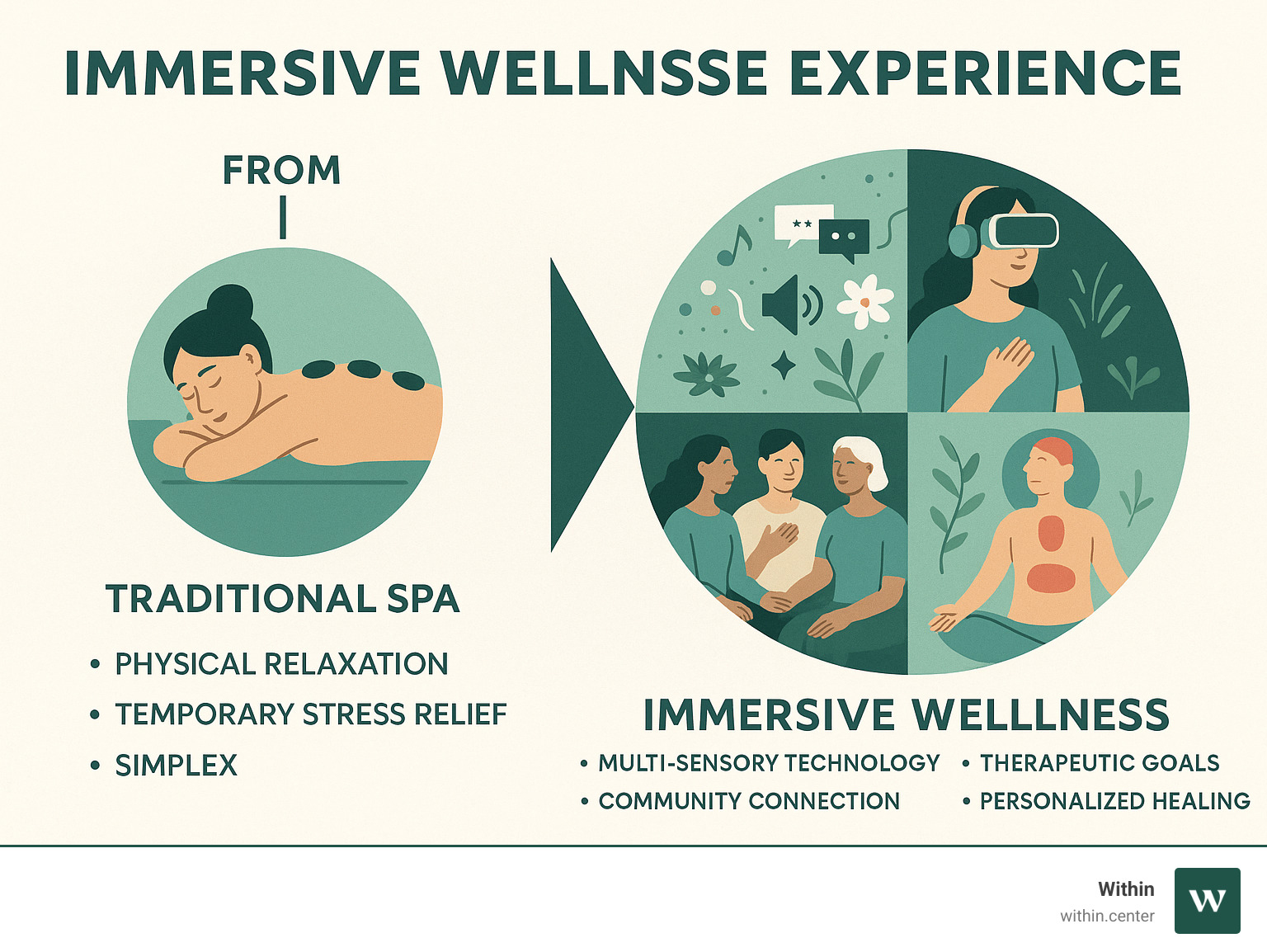
Comprehensive infographic showing the evolution from traditional spa treatments focused on physical relaxation and temporary stress relief to immersive wellness experiences that combine multi-sensory technology, therapeutic goals, community connection, and personalized healing approaches for lasting change - Immersive wellness experience infographic

What is an Immersive Wellness Experience?

An immersive wellness experience is a “state change machine,” guiding you into altered states of consciousness like awe, wonder, and transcendence. These feelings can fundamentally shift your perspective.

Unlike a typical spa day, this is a holistic healing journey engaging all your senses. Carefully crafted environments aim for real, lasting change, not just relaxation. The goal is to create a full-body shift that can rewire how your nervous system responds to stress, how you process emotions, and how connected you feel.

The Core of an Immersive Wellness Experience

Six key elements work together to create profound healing.

Embodiment is crucial. These experiences use multi-sensory environments to pull you from your head back into your body, making presence a felt sensation.

Mindfulness happens naturally. By removing distractions and using guided journeys, they foster a state of focused, present-moment awareness.

Emotional processing is improved. Safe, stimulating environments allow buried emotions to surface, providing space for acknowledgement and release.

Connection addresses modern loneliness by fostering deep connection to self, others, and the natural world.

Awe and wonder are therapeutic tools. They soften the ego, increase empathy, and spark creativity, opening your mind to positive change.

Neuroaesthetics is the science of how beautiful environments rewire our brains. Every design choice is intentional, leveraging this research for measurable positive change.

Beyond traditional therapy, awe and connection are becoming recognized as powerful healing forces that can create lasting change.

How It Differs from a Traditional Spa

While traditional spas focus on relaxation, an immersive wellness experience plays an entirely different game.

FeatureTraditional SpaImmersive Wellness Experience
GoalsRelaxation, pampering, temporary stress relief, physical comfortLasting change, emotional processing, nervous system regulation, liftd states of consciousness
MethodsMassages, facials, saunas, individual treatmentsMulti-sensory environments, VR and biometric technology, guided journeys, community experiences, ancient wisdom practices
OutcomesPhysical comfort, short-term rejuvenation, immediate stress reductionImproved mood and mindfulness, neuroplasticity, deep self-findy, lasting personal growth

The key difference is active participation. You are an explorer on a journey, not a passive recipient of a treatment. It’s an integrated journey where each element builds on the last to create a narrative of change.

The focus shifts from temporary physical comfort to long-term psychological change, altering how your brain and nervous system function. Imagine the difference between a relaxing massage and moving through a series of themed rooms, each with specific temperatures, scents, and visuals designed to guide you through different emotional states. Both have value, but only one is designed to help you leave fundamentally changed.

The Building Blocks of Immersion: Key Components and Technologies

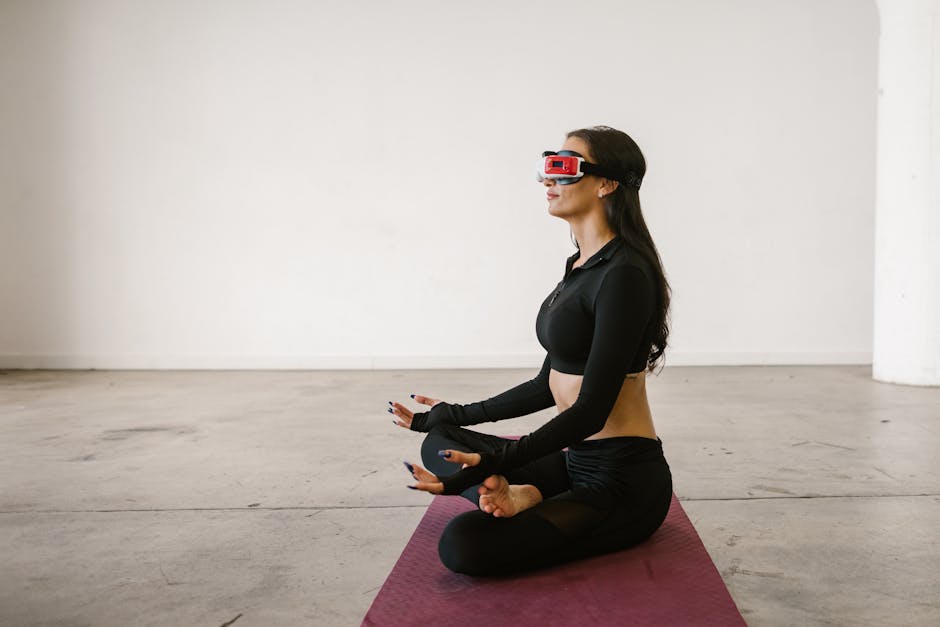
Person in VR headset - Immersive wellness experience

A transformative immersive wellness experience harmonizes ancient wisdom, modern science, art, and community. We amplify traditional healing practices with responsive technology, creating living environments that adapt to your healing journey.

Engaging All Five Senses

An effective immersive wellness experience thoughtfully engages all your senses to create a natural pathway for healing.

Sight becomes a gateway to change. High-definition screens can create cosmic landscapes, while natural materials and thoughtful lighting can shift your nervous system from stress to calm.

Sound therapy and vibro-acoustics use healing frequencies you can feel. Sound baths and specialized beds allow you to experience sound as a full-body massage from the inside out.

Smell has a direct line to your emotional brain. Aromatherapy uses scents chosen for their ability to shift mental states, like lavender for relaxation or eucalyptus for clarity.

Touch through thermotherapy and hydrotherapy creates powerful physiological shifts. Moving between a warm sauna and a cold plunge trains your nervous system to handle stress more effectively.

Taste can be part of the journey. The experience often includes nourishing foods that support the body’s healing process, because true wellness starts from within.

Technology’s Role in a Personalized Immersive Wellness Experience

Technology in wellness creates more personalized and responsive healing environments.

Virtual Reality (VR) can transport you to a peaceful beach for anxiety relief or a virtual temple for meditation, making experiences possible that the physical world can’t offer.

Augmented Reality (AR) transforms your physical space. For example, high-definition screens can turn rooms into immersive landscapes that adapt to your session’s therapeutic goals.

Biometric sensors monitor your heart rate and stress levels, allowing the environment to adapt in real time. If you’re stressed, the lighting or sound might adjust to calm you.

Artificial Intelligence (AI) is starting to create “cyberdelics”—personalized, generative experiences. It can learn what centers you and create custom environments just for you.

This technology serves the ancient goal of healing, using every available tool to help you find peace, connection, and the change you’re seeking.

For a fascinating look at how VR is changing meditation and mindfulness practices, check out A look at using VR for mindfulness.

The Science of Change: Benefits for Mind and Body

Person in nature - Immersive wellness experience

The benefits of an immersive wellness experience are rooted in science. These environments leverage neuroplasticity—your brain’s ability to form new connections. By engaging your senses and emotions, you actively create healthier neural pathways. Practices like alternating hot and cold therapies help with nervous system regulation, shifting you from a “fight or flight” to a calm, “rest and digest” state, which builds resilience to daily stress.

These experiences are also designed to induce flow states—joyful states of deep focus where time seems to disappear. When shared with others, this can create collective effervescence, a powerful sense of shared energy that strengthens bonds and helps you feel part of something bigger.

Psychological and Emotional Benefits

A primary benefit is stress reduction and anxiety relief. Studies show forest bathing can reduce anxiety in 81% of participants after one session. Private thermal spas and float tanks are also crafted to induce deep calm.

These experiences lead to an improved mood by promoting the release of endorphins and serotonin. They cultivate improved mindfulness through guided meditation, breathwork, and sensory focus. Sensory deprivation tanks can spark increased creativity by quieting external distractions. The community focus of many experiences helps in combating loneliness and fostering a sense of belonging, which is vital when 61% of Americans report feeling lonely.

While these experiences offer incredible benefits, seeking professional help for persistent stress, anxiety, or mood issues is a sign of strength. You can learn more about The importance of seeking mental health support.

Physiological and Physical Benefits

The physical advantages are equally compelling. Many journeys provide immune system support, with specialized thermal rooms or immunity programs designed to strengthen your body’s natural defenses. Therapies like red-light therapy or hot stone saunas can offer pain relief for muscles and joints. Cryotherapy (cold exposure) can lead to improved circulation and reduced inflammation.

Deep relaxation also leads to better sleep. Lastly, elements like saunas and hydrotherapy aid in detoxification, helping your body cleanse and refresh itself.

For those curious about even deeper healing modalities that intertwine with physiological well-being, exploring options like The Ketamine Therapy Experience can provide valuable insight.

The Spectrum of Immersive Wellness: From Nature to Technology

Group wellness activity - Immersive wellness experience

The beauty of immersive wellness experiences lies in their incredible diversity. From nature retreats to high-tech centers, there’s a path for every healing journey.

Different types of immersive wellness settings include:

  • Nature-based retreats and forest bathing experiences
  • Multi-sensory art installations and sound temples
  • High-tech wellness centers with VR, AR, and biometric feedback
  • Traditional and modern bathhouses with hot and cold therapies
  • Sensory deprivation float tanks
  • Vibro-acoustic therapy beds
  • Psychedelic-assisted therapy retreats
  • Community-focused wellness programs

Nature-Based Immersion

Returning to nature is a powerful form of healing.

Forest bathing (Shinrin-yoku) is a Japanese practice of mindfully immersing yourself in a forest. Research shows it can significantly reduce stress, with 81% of participants feeling less anxious after one session.

Wellness sabbaticals are longer-term retreats in nature designed for sustainable change.

Regenerative health focuses on nature’s measurable biomedical effects on our well-being.

Wilderness expeditions are guided journeys that combine physical challenges with opportunities for self-findy.

Grounding practices, like walking barefoot on the earth, can have powerful calming effects.

Art, Culture, and Community

Art is a healing force, and modern experiences are refinding this truth.

Immersive art installations use light, sound, and space to alter perception and evoke deep emotions.

Sound baths, using resonant frequencies from instruments or vibro-acoustic beds, induce deep relaxation and meditative states.

Movement and dance sessions help participants achieve flow states and release emotional blockages.

Shared reflection spaces are becoming vital “third spaces” for connection and community, which is crucial for combating loneliness.

Cultural prescriptions, such as visits to museums, are now being recognized for their genuine therapeutic value.

To understand how shared experiences can profoundly transform mental health, explore How community transforms mental health.

Technology-Driven and Psychedelic-Assisted Journeys

At the cutting edge, new technologies and therapies are creating new possibilities for healing.

Vibro-acoustic beds use low-frequency vibrations synchronized with soundscapes to induce profound relaxation. You feel the healing throughout your body.

Sensory deprivation tanks remove external stimuli, allowing for effortless floating that leads to deep relaxation, self-reflection, and creativity.

Guided VR meditations can transport you to serene landscapes, which is especially helpful for those who find traditional practice difficult.

Psychedelic-assisted therapy is a significant frontier in wellness. With growing scientific support, treatments like ketamine-assisted therapy are gaining acceptance for conditions like depression, anxiety, and PTSD.

At Within Center, located near Austin, Texas, we offer an immersive, live-in retreat experience at AWKN Ranch. Our approach combines ketamine-assisted therapy with comprehensive integration support and a strong community focus. This creates a holistic healing environment that blends ancient wisdom with modern medical understanding for profound, lasting change.

For a detailed explanation of this innovative therapy, read What is Ketamine Therapy?.

The Future is Immersive: What’s Next in Wellness?

The future of wellness is about thriving, not just fixing problems. This forward-looking approach is deeply immersive, blending ancient wisdom with the latest science and technology.

Future Trends and Innovations

Get ready for amazing developments in the next wave of immersive wellness experiences.

AI-driven personalization will use biometric and genetic data to create hyper-personalized wellness journeys, customizing every sensory element for you.

Advances in neurotechnology will offer more precise ways to support cognitive function, such as real-time brain training for focus or calm.

Virtual wellness immersions, accelerated by the pandemic, will make powerful healing environments more accessible from home.

As science validates their potential, mainstreaming of psychedelic healing will continue. Psychedelic-assisted therapies, like those at Within Center, will become more accepted, offering profound change in supportive, immersive settings.

Keep an eye on the rise of “third spaces” for wellness. As traditional gathering spots fade, immersive wellness centers will become vital hubs for connection and renewal, combating loneliness.

Incorporating Immersive Principles into Daily Life

You can weave these powerful principles into your everyday life for continuous well-being.

  • Sensory rituals at home: Use sensory rituals, like lighting a candle for aromatherapy or mindfully sipping tea.
  • Mindful tech use: Use guided meditation apps or soothing soundscapes intentionally as tools for peace.
  • Creating a personal sanctuary: Designate a small, cozy, distraction-free space in your home for relaxation.
  • Nature walks: Take mindful walks in nature, engaging all your senses.
  • Curating playlists for mood: Create playlists to energize, calm, or focus your mind.
  • Breathwork practices: Simple breathwork can regulate your nervous system and reduce stress anywhere.

Considerations and Potential Drawbacks

While the future is bright, it’s important to consider a few practical points.

Accessibility and cost is a challenge, as many high-end experiences can be expensive. At Within Center, we believe in making holistic healing accessible.

For some, highly sensory environments might lead to over-stimulation. It’s important to know your sensitivities and choose experiences that feel right for you.

The importance of integration is crucial. A powerful experience is just the start. Lasting change requires integrating insights into daily life. This is why comprehensive integration support is a core part of our approach at Within Center.

When exploring options, focus on finding credible providers. Research providers to ensure they are reputable, safe, and use evidence-based practices, especially for newer therapies.

Understanding how important this follow-through is, especially after a deeply transformative experience, is key. You can learn more about How Important is the Therapy Component of Ketamine Therapy?.

Frequently Asked Questions about Immersive Wellness

It’s natural to have questions when exploring something as new and transformative as an immersive wellness experience. Here are some common questions about the practicalities.

What should I expect during my first immersive wellness experience?

Expect a guided, multi-sensory journey designed to engage your senses and help you relax, focus, and connect with yourself. You might move through themed spaces with unique lighting and sounds. The main goal is to help you let go and allow the environment to guide you toward a state of deep well-being.

Are these experiences done alone or in a group?

Experiences can be either solo or in a group. Some are designed for private introspection, like a float tank or a private thermal circuit. Others emphasize shared healing and community, with small groups moving through a space together or participating in communal activities like sauna and ice bath sessions. The choice depends on whether you seek personal reflection or connection.

How long does an immersive wellness experience typically last?

The duration of an immersive wellness experience varies widely. Some focused sessions can be as short as 10-30 minutes, offering a quick reset. More comprehensive journeys typically last 75 minutes or more, allowing for a deeper dive. For the most profound change, wellness sabbaticals can last for weeks or even months, allowing for full integration and lasting personal growth.

Conclusion

The shift from passive relaxation to active, personal change marks a new era in wellness. Immersive wellness experiences are carefully designed journeys that help us rewire our brains, regulate our nervous systems, and reconnect with ourselves and others in meaningful ways.

At a time when 61% of Americans feel lonely and anxiety is on the rise, traditional approaches often fall short. Immersive wellness offers genuine healing that our disconnected world desperately needs. From forest bathing that reduces anxiety to technology-improved environments that alter consciousness, the goal is profound, measurable change.

The journey to well-being is deeply personal, yet it’s often enriched by expert guidance and community support. The integration of insights gained during these powerful experiences into daily life is what transforms a single session into lasting growth.

For those ready to explore deeper healing modalities, a Psychedelic Therapy Retreat can be a transformative step toward holistic wellness. At Within Center, we understand that true healing happens not just during the experience itself, but in the comprehensive support and community connection that follows.

Immersive wellness experiences represent more than a trend—they’re a powerful tool for addressing modern challenges and refinding our capacity for profound well-being and connection.

The Doorway In: How Psychedelic Therapy and Community Care Are Transforming Mental Health at Within Center

By Psychedelic Therapy RetreatNo Comments

In June 2025, researchers at the Psychedelic Science conference released results that might change how we treat depression for good: 67% of participants who received a single dose of psilocybin-assisted therapy reported being in remission five years later.

That’s not just impressive it’s revolutionary.

Meanwhile, another trial, this time involving a psychedelic nasal spray, showed meaningful reductions in depression symptoms within 24 hours, even with shorter therapist supervision. The results suggest new, more scalable models of care for those struggling with treatment-resistant conditions like major depressive disorder or PTSD (Financial Times).

All of this points to a clear truth: psychedelic medicine is not only here to stay it’s evolving. And while the science advances, the question becomes more human: How do we translate these breakthroughs into real healing for real people?

At Within Center in Austin, Texas, that question lives at the heart of everything we do.


A Healing Space Rooted in Connection and Care

We don’t believe healing comes from a single moment or molecule. We believe it begins within in the right space, with the right support, at the right time.

At our center, we combine clinical ketamine therapy with integrative wellness, group retreat experiences, and long-term community support. We’re not just offering medicine we’re offering a process of reconnection: to body, to breath, to purpose.

And that process works.

Over 91% of our clients report measurable improvements in their mental health after 4–6 guided ketamine sessions, supported by therapy, nutritional support, and integration coaching. And for many, what begins as a search for relief becomes the start of a whole new chapter.


The Science Is Catching Up to What We Know Deep Down

The new research confirms what we’ve witnessed for years: that with the right container, a single psychedelic session can shift decades of suffering. But here’s the key it’s not just the medicine.

“Ketamine opens a doorway but it’s what happens afterward that shapes the journey. Our work is about holding people in that process, helping them discover clarity, courage, and connection,” says David, our Founder at Within.

That container includes not just trained clinicians and guides but a genuine sense of being seen, and being held, through every phase of the experience.


Who We Serve

Many of our clients are high-achieving, high-functioning adults entrepreneurs, veterans, executives, parents who’ve “done the work” through therapy, self-help, and even medication, but still feel stuck.

They come to us burned out, grieving, anxious, or facing a major life change. And more often than not, they’re looking for something deeper than just symptom relief.

They’re looking for a way back to themselves.

And that’s where we begin.


Our Approach: Science + Soul

At Within, we offer a uniquely integrated care model that combines:

    • Clinical ketamine-assisted therapy for safe, legal psychedelic experiences
    • Retreat-based healing on our private ranch, with guided sessions, breathwork, yoga, nature immersion, and ceremonial practices
    • Functional and integrative medicine, including lab testing, IV therapy, gut and hormonal health support
    • Mental health therapy and coaching, both during the process and well beyond
    • Community and peer support, including ongoing integration groups, classes, events, membership, fitness, and lifestyle planning

This structure helps our clients move from fragmented and reactive care multiple specialists with no communication to a single, held, and holistic container for deep personal transformation.


Our Retreat Experience

Much more than a “treatment,” our retreats are immersive healing journeys.

Taking place at our private ranch just outside Austin, guests are invited to unplug, slow down, and reset. Our 30+ day retreat programs include:

    • 4–6 ketamine-assisted therapy sessions with medical supervision and emotional support
    • Daily breathwork, yoga, and nervous system-focused movement
    • Community processing circles and private coaching
    • Whole-food, plant-based meals designed for brain and gut healing
    • Optional ceremonial practices rooted in indigenous wisdom
    • Cold plunges, sauna, hiking, and nature reconnection
    • Personalized aftercare planning and continued integration sessions

By stepping out of everyday life and into a sacred, supported space, our guests are able to do the deep inner work that often isn’t possible in a standard clinical environment.


Why Integration Matters

The biggest misconception in psychedelic therapy is that the session itself is the healing.

In truth, that’s just the opening.

Without skilled integration space to process, practice, and embody the insights a powerful experience can fade quickly, or even become destabilizing.

That’s why we provide integration coaching, therapy, nutrition, and lifestyle support for at least 30 days post-treatment, with many clients continuing in our community well beyond that. It’s not about prolonging the “trip” it’s about weaving it into your life in meaningful, lasting ways.


A Word on Safety

We take medical and psychological safety seriously. Every client undergoes a thorough intake, medical evaluation, and mental health screening before treatment begins. During sessions, clients are monitored by licensed professionals and held by experienced guides.

Our team is trained in trauma-informed care, and our campus is designed to foster both peace and privacy.

Psychedelic therapy is powerful but it must be done responsibly. That’s our commitment to you.


Back to the Big Picture

The latest research from Psychedelic Science 2025 confirms something deeply hopeful: healing can happen faster, deeper, and more permanently than we once believed.

But what the studies don’t always show is how that happens.

At Within Center, we believe it happens in relationships. In sacred spaces. In trust. In being witnessed, held, and guided through the tender, transformative moments that rewire not just the brain but the heart.

This isn’t a service we offer. It’s a path we walk with you.


An Invitation to Begin

If you’re reading this, something inside you might be ready. Ready to feel again. To face the grief. To reconnect. To finally let go of what’s not yours to carry.

We won’t pretend to have all the answers. But we do know how to hold the questions.

Whether you’re exploring ketamine-assisted therapy for the first time, or you’ve been walking this path for a while we’re here.

To guide, to witness, and to walk with you.

From within.

Connect With Us

If you’re curious about working with us whether through outpatient therapy, a healing retreat, or simply learning more about what we offer we invite you to reach out.

Connect with Within Center

We’re honored to walk this path with you.